
Divisional: Operations Lesson 2
Operations Module 2: “Using Core Ministry Counts (CMC) to Lead Well”
Audience: i100 Divisional Groups
Duration: 60–75 minutes
Format: Self-guided Online Lesson
Lesson Objectives
By the end of this lesson, participants will be able to:
- Understand the purpose and value of Core Ministry Impact (CMI) beyond reporting compliance.
- Use CMC data to support vision, leadership, and field decision-making.
- Learn from real examples how leaders use CMC data to support and grow ministry.
1.) Welcome: Why CMC Matters (5 minutes)
"What gets measured gets noticed. Core Ministry Counts (CMI) are more than a report—they’re a way to see what God is doing across your area and how we can lead with wisdom and care.”
2.) What Is CMC? (10 minutes)
CMI
Core Ministry Impact is our practice of real-time measurement that allows us to gain insight into the core health of a ministry, empowering staff and volunteers to understand, celebrate, and focus on the important work of reaching and teaching more adolescents
CMC (Core Ministry Counts)
Core Ministry Counts (CMC) is a tool within YL Connect that provides a place for the mission to track - Kids Known by Name (KKBN), Club, Campaigners, Volunteers, Staff as well as Camping data. To fulfill this requirement, we track students' names and monitor Club, Campaigner and Camp attendance. Each month, ministries should enter:
- Number of Kids Known by Name each month. The total number of Kids Known by Name with whom a leader has met (in person), can call by name and is praying for
- Number of Students and Leaders at Club each week (or indicating no event).
- Number of Students and Leaders at Campaigners each week (or indicating no event).
- Number of Students and Leaders at each Camp Event
- Number of Volunteers and Staff in a location
- As well as other information that different depending on Division, like Male and Female number as well as Focused Ministry counts
PURPOSE
- Gives a clear picture of where and how ministry is happening
- Helps identify growth, needs, and areas of strength
- Creates a common language and consistency across geographies
Interactive Activity
“Which part of this data tells you the most about your geography?”
3.) Using CMC to Celebrate, Find the Story, Supervise, and Make Strategic Decisions (15 minutes)
Mini-Teaching or Audio Segment:
In the video above, Pratt shares multiple examples of how the teams in Mexico use CMC data to celebrate growth and change in their ministry, but also how they work to see the story that the data tells them and make decijsions accordingly. He key stories he tells of how the Mexico team uses CMC are:
- The story behind creating a leader pipeline
- Strategic goals around a Kids Known by Name Campaign
- Strategic Planning to Diversify Club Model
- Rethinking Camping Models to better serve kid who could not attend camp
- Measuring Community Partner Involvement and making strategic goals to strengthen these partnerships.
Data tells a story! As you listen to Pratt’s story and explore the case study below, start to consider how you can use CMC data to help you celebrate the work of your ministry but also make strategic decisions.
Here are some more examples of how to use CMC data:
- Spot areas with high kid reach but no staff or high staff/leaders but little kid reach
- Identify geographies where leadership is expanding or declining
- See which areas may need recruitment or training support
- Use trends to inform budgets, training, and prayer
- Inform need to concentrated efforts around contact work, club or campaigners
- And MORE!!
Discussion Prompt
How do you currently use CMC (or don’t)? What new way could you begin using it to support your teams?
4.) (15 minutes) “From Camp to Commitment.”
Background
Peter serves as the Country Director for Young Life in the small country of San Aurelio (population 2 million). He leads a team of 5 staff—each serves as an Area Director in a different part of the country. The ministry is growing steadily, with around 400 kids connected through clubs, school visits, and camp.
This past summer, the national team ran two weeklong camps – one week was WyldLife and one for Young Life. They were a huge success:
- 150 total campers attended (a 25% increase from last year)
- 30% of students (45 kids) indicated they took a step of faith during camp (either beginning a relationship with Jesus or renewing it)
The camp follow-up week was exciting. Leaders felt momentum. Students were enthusiastic, posting camp photos and stories on social media.
But two months later, when Peter reviewed the CMC data, he noticed a problem.
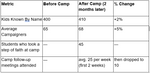
The CMC Data Snapshot
Observation
Even though 45 kids took steps of faith, the number of students in Campaigners increased by only 3.
The Challenge
Peter feels tension. He’s grateful for the spiritual impact at camp, but is concerned that transformation hasn’t led to discipleship. His staff is busy and tired after the camp season. In fact, most of them head off on vacation right after the camp weeks. Right after the biggest weeks of the ministry year, his staff often disappear for some time of rest instead of engaging with kids who’ve taken steps of faith. He knows that each area has a follow-up picnic or activity during the week after camp, but he’s not sure if each area is focused on the discipleship follow-up right after camp. When he brings up the numbers, a few staff members say:
- “Kids are on vacation after camp – they can’t commit to coming to Bible Studies regularly. It’s better to wait until school starts and they have a normal schedule.”
- “We invite everyone to come, but we still have the same group as last year coming to Campaigners.”
- “We don’t want to pressure them; they’ll come when they’re ready.”
- “Kids are busy with school and activities – they don’t have time.”
Peter believes God truly moved at camp, and he wants his team to see the gap between decisions and discipleship—not as failure, but as an opportunity for growth. He wants to use the collected data to help the staff visualize what’s happening and brainstorm next steps.
Discussion QUESTIONS
1. Data Interpretation:
- What story is the data telling?
- What might explain why 30% took steps of faith, but the Campaigner numbers barely changed?
- Are there patterns or trends in contact work or follow-up attendance that stand out?
2. Follow-Up Strategy:
- What could the team do differently to connect campers to ongoing discipleship?
- When is the team beginning discipleship follow-up after camp?
- How could the data guide specific staff actions (e.g., follow-up calls, leader assignments, small group launches)?
3. Leadership Reflection:
- How might Peter communicate these findings in a way that motivates rather than discourages the team?
- What tools or visuals (charts, graphs, stories) could make the data more compelling?
4. Faithfulness vs. Fruitfulness:
- How does the team balance celebrating camp decisions with pursuing deeper spiritual growth?
- What measures of success should they track going forward?
Next Step Options for Peter
- Visualize the Data: Create a simple chart showing “Steps of Faith vs. Bible Study Involvement.”
- Facilitate a Reflective Staff Meeting: Present the data, ask open-ended questions, and let staff brainstorm causes and solutions.
- Develop a Follow-Up Plan: Assign each staff person to re-contact their campers, invite them personally to Campaigners, or start a “New Faith” small group.
- Track Movement Over Time: Revisit numbers monthly for three months to see if interventions change the trend.
5.) Call to action
Review the CMCs of the geographies you supervise or interact with. Write down one insight or question you want to explore with that leader


